📩 info@irisprotectionservices.com 📲 (657) 214-0877 🏛️ Iris Protection Services, Inc 🛂 License No. PPO120833

Concierge Security vs. Traditional Security Guards: Which Is Right for Your Property?
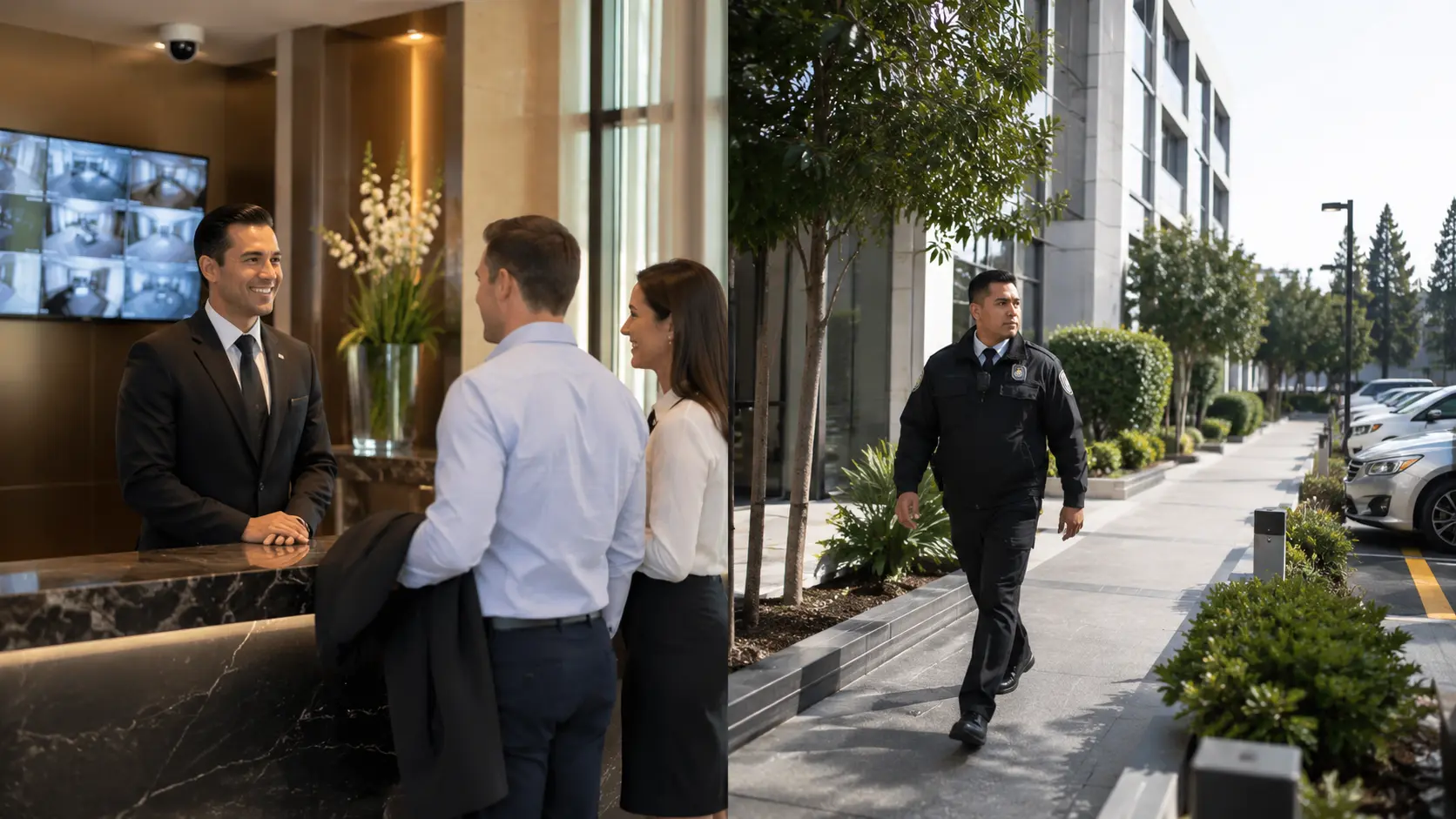
Security is no longer simply about placing a guard at an entrance and responding when something goes wrong. For many residential communities, luxury apartments, hotels, office buildings, and mixed-use properties, security personnel is also part of the property’s overall customer experience.
This has led to growing interest in concierge security, a service model that combines traditional security responsibilities with hospitality-focused customer service.
But how does concierge security differ from traditional security guards? Which approach is better for your property? And when does it make sense to combine the two?
The answer depends on the property’s security risks, clientele, operating environment, and expectations for resident or guest service.
What Is Concierge Security?
Concierge security combines security, access control, visitor assistance, and hospitality-oriented customer service.
A concierge security officer may perform many of the same protective duties as a traditional security officer while also serving as a professional point of contact for residents, tenants, guests, and visitors.
Depending on the property, responsibilities may include:
- Greeting residents and visitors
- Monitoring building entrances
- Verifying visitors and credentials
- Managing access control
- Assisting with deliveries
- Providing directions
- Monitoring common areas
- Conducting security patrols
- Responding to security concerns
- Documenting incidents
- Coordinating with property management
- Assisting during emergencies
The objective is to create an environment that is both secure and welcoming.
What Are Traditional Security Guards?
Traditional security guards primarily focus on protecting people and property, deterring unauthorized activity, monitoring security conditions, and responding to incidents.
Depending on the assignment, a traditional security officer may:
- Conduct foot patrols
- Conduct vehicle patrols
- Monitor entrances and exits
- Control access
- Observe CCTV systems
- Respond to alarms
- Monitor parking facilities
- Inspect property perimeters
- Document incidents
- Respond to disturbances
- Coordinate with emergency services when appropriate
The exact duties depend on the property’s post orders, security plan, and operational requirements.
Concierge Security vs. Traditional Security: Key Differences
| Factor | Concierge Security | Traditional Security |
|---|---|---|
| Primary Focus | Security + hospitality | Security and protection |
| Guest Interaction | High | Assignment dependent |
| Access Control | Yes | Yes |
| Customer Service | Major responsibility | Supporting responsibility |
| Patrols | Depending on property | Common |
| Visitor Assistance | Extensive | As required |
| Building Appearance | Hospitality-oriented | Security-oriented |
| Best Environment | Luxury residential, hotels, offices | Commercial, industrial, construction, retail |
| Resident/Tenant Experience | Central to role | Secondary to security duties |
| Security Response | Yes | Yes |
Neither model is inherently superior. The right choice depends on what the property needs from its security personnel.
What Does a Concierge Security Officer Actually Do?
Concierge security officers operate at the intersection of security and hospitality.
A typical shift might include:
Greeting Residents and Visitors
The officer welcomes people entering the property while remaining alert to security concerns.
A professional greeting can establish a positive first impression without compromising security.
Managing Building Access
The officer may verify:
- Resident credentials
- Visitor authorization
- Contractor identification
- Delivery access
- Employee credentials
Assisting Residents
Depending on the property and assignment, concierge security personnel may help residents with directions, visitor access, package procedures, building information, and other basic requests.
Monitoring the Property
Security remains a core responsibility.
Officers may monitor:
- Entrances
- Lobbies
- Elevators
- Parking areas
- Common spaces
- Building perimeters
- Restricted areas
Responding to Security Concerns
Concierge security personnel are still security professionals. They observe, assess, document, and respond to security situations according to established procedures.
Where Concierge Security Works Best
Concierge security is particularly well suited to properties where security and customer experience are closely connected.
Luxury Apartment Buildings
High-end residential communities often want residents to encounter a professional security presence without creating an intimidating atmosphere.
Concierge security can provide:
- Lobby security
- Resident assistance
- Visitor management
- Package coordination
- Access control
- Security patrols
Condominium Communities
Condominium associations may use concierge security to improve both access management and resident experience.
Luxury Hotels
Hotels require a careful balance between guest hospitality and security.
Concierge security personnel can help protect guests while maintaining the professional service standards expected in hospitality environments.
Class A Office Buildings
Corporate tenants and visitors may expect a polished front-of-house experience.
Concierge security can combine:
- Reception support
- Visitor management
- Credential verification
- Lobby monitoring
- Emergency response
- Access control
Mixed-Use Developments
Mixed-use properties combine residential, commercial, retail, and public spaces, creating complex security requirements.
A concierge security model can help integrate security into the overall property experience.
Where Traditional Security Guards May Be Better
Traditional security services may be more appropriate when the primary objective is deterrence, patrol, asset protection, or site monitoring.
Construction Sites
Construction properties often require:
- Perimeter patrols
- Equipment protection
- Access control
- Gate monitoring
- After-hours inspections
A traditional security model may be more practical than a hospitality-oriented position.
Warehouses
Warehouse security typically emphasizes:
- Loading dock monitoring
- Employee access
- Vehicle access
- Inventory protection
- Perimeter security
Industrial Facilities
Industrial properties may require specialized patrols, access control, and safety monitoring rather than front-desk hospitality.
Vacant Properties
Vacant buildings generally need deterrence, patrols, inspections, and incident reporting rather than concierge services.
Large Outdoor Properties
Properties with extensive perimeters may benefit from mobile patrols and traditional security operations.
Concierge Security Does Not Mean “Security Lite”
One common misconception is that concierge security is simply a receptionist wearing a security uniform.
That is not the objective.
A properly trained concierge security officer must be capable of maintaining professional customer service while remaining attentive to security responsibilities.
The officer may simultaneously need to:
- Welcome a visitor
- Verify credentials
- Observe the lobby
- Identify unusual behavior
- Communicate with property management
- Respond to an incident
The hospitality component should complement—not replace—the security function.
The Importance of Professional Communication
Concierge security requires strong interpersonal skills.
Officers regularly interact with:
- Residents
- Executives
- Guests
- Employees
- Contractors
- Vendors
- Property managers
They must communicate professionally while enforcing security procedures.
For example, refusing unauthorized access does not have to result in an uncomfortable confrontation. A trained officer can explain the property’s requirements clearly and respectfully while maintaining the security boundary.
Appearance and Professionalism Matter
Because concierge security personnel frequently work in highly visible areas, presentation is particularly important.
Important qualities include:
- Professional appearance
- Clean uniform
- Good communication
- Confidence
- Courtesy
- Situational awareness
- Discretion
- Reliability
The officer’s behavior becomes part of the property’s overall image.
Access Control in Concierge Security
Concierge security can provide sophisticated access management while maintaining a hospitality-focused experience.
Depending on the property, officers may manage:
- Electronic key cards
- Visitor credentials
- Guest lists
- Contractor access
- Delivery personnel
- Parking access
- Building elevators
- Restricted areas
The objective is to prevent unauthorized access without creating unnecessary friction for legitimate residents and guests.
Concierge Security and Package Management
Package deliveries are an increasingly important consideration for residential properties.
Depending on the assignment, concierge security personnel may assist with:
- Delivery access
- Package room monitoring
- Courier verification
- Restricted building access
- Reporting suspicious deliveries
Procedures should be clearly defined so security officers do not assume responsibilities outside their assigned duties.
Emergency Response
Customer service does not eliminate the need for emergency preparedness.
Concierge security personnel may be expected to support responses involving:
- Medical emergencies
- Fire alarms
- Evacuations
- Unauthorized access
- Security incidents
- Suspicious activity
- Building emergencies
Officers should understand the property’s emergency procedures and communication protocols.
Traditional Security Can Also Be Customer-Focused
The distinction between concierge security and traditional security is not absolute.
A traditional security officer can—and should—provide professional customer service.
The difference is generally one of emphasis.
A traditional guard’s primary responsibility may be security patrols, access control, asset protection, and incident response.
A concierge security officer has those responsibilities while placing greater emphasis on resident, tenant, and guest interaction.
Can Concierge and Traditional Security Be Combined?
Absolutely.
A hybrid model can provide both front-of-house service and broader property protection.
For example, a luxury residential community might use:
Concierge Security
- Main lobby
- Visitor management
- Resident assistance
- Access control
Mobile Patrol
- Parking areas
- Perimeter
- Garages
- Remote property areas
This provides a polished front-of-house experience while extending security coverage across the entire property.
Benefits of Concierge Security
Enhanced Resident Experience
Residents receive assistance from a professional security presence that is also trained in customer service.
Stronger Access Control
Visitors and contractors can be verified without creating an unnecessarily confrontational environment.
Professional First Impression
The security officer may be one of the first people a visitor encounters.
Improved Communication
Concierge security personnel can serve as a communication link between residents, visitors, security management, and property management.
Visible Security Presence
A professional officer provides deterrence while maintaining an approachable appearance.
Benefits of Traditional Security
Strong Deterrence
Visible patrols and security personnel can discourage unauthorized activity.
Property Protection
Traditional security is well suited to protecting equipment, inventory, facilities, and restricted areas.
Broad Patrol Coverage
Mobile and foot patrols can cover large properties.
Specialized Assignments
Traditional security models can be adapted to construction, industrial, warehouse, retail, and other higher-risk environments.
How to Choose the Right Security Model
Before selecting a service, property owners and managers should consider:
1. What Is the Primary Security Objective?
Is the primary concern:
- Access control?
- Resident safety?
- Theft prevention?
- Perimeter security?
- Visitor management?
- Asset protection?
2. How Important Is Customer Experience?
Luxury residential and hospitality properties may place greater emphasis on customer-facing service.
3. How Large Is the Property?
Large properties may require mobile patrols in addition to stationary personnel.
4. What Type of Property Is It?
A hotel has different security needs from a warehouse or construction site.
5. How Much Visitor Traffic Exists?
High visitor volumes can make professional access control particularly important.
6. Are There High-Value Assets?
Properties containing expensive equipment, inventory, or sensitive facilities may require additional security measures.
7. What Are the Existing Security Systems?
Consider how security personnel will interact with:
- CCTV
- Access control
- Alarms
- Visitor management
- Parking systems
Concierge Security vs. Traditional Security: Quick Guide
| Property Type | Recommended Approach |
|---|---|
| Luxury Apartment | Concierge Security |
| Luxury Condominium | Concierge Security |
| Hotel | Concierge Security |
| Class A Office Building | Concierge Security |
| Mixed-Use Development | Concierge + Patrol |
| Construction Site | Traditional Security |
| Warehouse | Traditional Security |
| Industrial Facility | Traditional Security |
| Vacant Property | Mobile Patrol |
| Large Residential Community | Concierge + Mobile Patrol |
| Retail Center | Traditional or Hybrid |
| Corporate Campus | Concierge + Patrol |
These are general guidelines. A professional security assessment should determine the appropriate staffing model for each property.
How Technology Supports Concierge Security
Concierge security can be enhanced through modern technology, including:
- Electronic access control
- CCTV surveillance
- Visitor management systems
- Video intercoms
- Digital incident reporting
- Electronic key systems
- Parking access systems
- Emergency communication systems
Technology should support the officer’s responsibilities rather than replace professional judgment and human interaction.
What Should Property Managers Look for in a Concierge Security Provider?
When evaluating providers, consider:
- California licensing and regulatory compliance
- Officer training
- Customer service training
- Experience with similar properties
- Supervisor availability
- Incident reporting procedures
- Emergency response protocols
- Staffing reliability
- Communication with property management
- Ability to customize post orders
The provider should understand that concierge security requires both security competence and hospitality professionalism.
Frequently Asked Questions
Is concierge security the same as a security guard?
Concierge security personnel perform security functions but typically have a stronger emphasis on hospitality, resident assistance, visitor management, and customer-facing service.
Is concierge security more expensive than traditional security?
Pricing varies based on staffing requirements, hours, property size, officer qualifications, and the scope of services. Concierge assignments may involve additional customer-service responsibilities and specialized training.
Is concierge security appropriate for apartment buildings?
Yes. Concierge security can be particularly effective for luxury apartments, condominiums, and residential communities where access control and resident experience are both important.
Can concierge security officers conduct patrols?
Yes, depending on the property’s post orders and staffing arrangement. Some concierge assignments include periodic patrols, while others combine a lobby officer with separate mobile or foot patrol coverage.
Can concierge security replace a concierge?
That depends on the property’s operational requirements. Security officers should not automatically be expected to perform unrelated concierge or property management duties. Responsibilities should be clearly defined in the service agreement and post orders.
Which is better: concierge security or traditional security?
Neither is universally better. Concierge security is generally better suited to properties where hospitality and security must work together, while traditional security may be more appropriate for properties focused primarily on patrols, access control, asset protection, or perimeter security.
Conclusion
The difference between concierge security and traditional security guards is primarily about the balance between security responsibilities and hospitality-oriented service.
Concierge security is particularly valuable for luxury residential communities, hotels, Class A office buildings, condominiums, and mixed-use properties where residents, tenants, and guests expect both protection and professional assistance.
Traditional security remains highly effective for construction sites, warehouses, industrial facilities, vacant properties, and other environments where patrols, access control, deterrence, and asset protection are the primary priorities.
For many modern properties, however, the best solution may be a combination of concierge security, stationary security, mobile patrols, surveillance technology, and access control.
The right security strategy should be based on the property’s layout, risk profile, operating environment, and expectations for customer service. A professional security provider can assess these factors and develop a customized program that protects the property while maintaining the experience residents, tenants, employees, and visitors expect.
For properties throughout Los Angeles and Southern California, IRIS Protection Services provides customized security solutions designed to balance professional protection with the service standards expected by today’s residential, commercial, hospitality, and mixed-use properties.