📩 info@irisprotectionservices.com 📲 (657) 214-0877 🏛️ Iris Protection Services, Inc 🛂 License No. PPO120833
AI in Private Security: Threat or Force Multiplier?
Artificial intelligence is moving from the technology sector into almost every part of the security industry.
AI-powered video analytics can identify unusual activity. Intelligent surveillance systems can monitor large numbers of cameras simultaneously. Access-control platforms can analyze events in real time. Automated systems can prioritize alerts, search video footage, and help security teams identify incidents more quickly.
For private security companies and the businesses they protect, this creates an important question:
Is artificial intelligence a threat to private security—or a force multiplier?
The honest answer is that both are possible.
AI can make a security operation more efficient, improve situational awareness, reduce the amount of repetitive monitoring performed by guards, and help security professionals focus on incidents that require human attention.
But AI can also introduce false alarms, privacy concerns, cybersecurity vulnerabilities, overreliance on automated systems, and new operational risks.
For businesses, the goal should not be to deploy AI simply because it is available.
The goal should be to determine where AI genuinely improves security and where a trained human professional remains essential.
What does AI mean in private security?
In private security, artificial intelligence generally refers to software systems capable of analyzing information and identifying patterns or events without requiring a person to manually examine every piece of data.
One of the most visible applications is AI-powered video analytics.
Traditional CCTV systems can record enormous amounts of video, but a human operator may have to watch screens or search recordings to identify a particular event.
AI-assisted systems can analyze video continuously and generate alerts when predefined conditions are detected.
Depending on the system, those conditions might include:
- A person entering a restricted area
- Movement during prohibited hours
- An object being left in a particular location
- A person crossing a virtual boundary
- Unusual crowd activity
- Vehicle activity
- Certain types of behavior
- Access-control anomalies
The technology can therefore function as an additional layer between raw security data and the human professional responsible for responding to it.
Why is AI attractive to private security companies?
The private-security industry deals with a fundamental problem:
There is far more security data than a human can continuously process.
A commercial property may have dozens or hundreds of cameras, access-control records, alarms, sensors, and other sources of information.
A guard can monitor a particular environment effectively, but no person can maintain perfect attention across every camera and sensor every second of every day.
AI can process large amounts of information continuously.
That makes it potentially valuable as a force multiplier.
Instead of requiring guards to manually monitor everything, an AI system can help identify events that deserve attention.
The guard can then focus on verification, response, communication, and decision-making.
How can AI make security guards more effective?
The strongest argument for AI in private security is not that it eliminates human guards.
It is that it can help guards do more with the information available to them.
Consider a security officer responsible for a large commercial property.
Without intelligent analytics, the guard may have to monitor numerous camera feeds while simultaneously responding to access-control events, alarms, radio communications, employees, visitors, and other responsibilities.
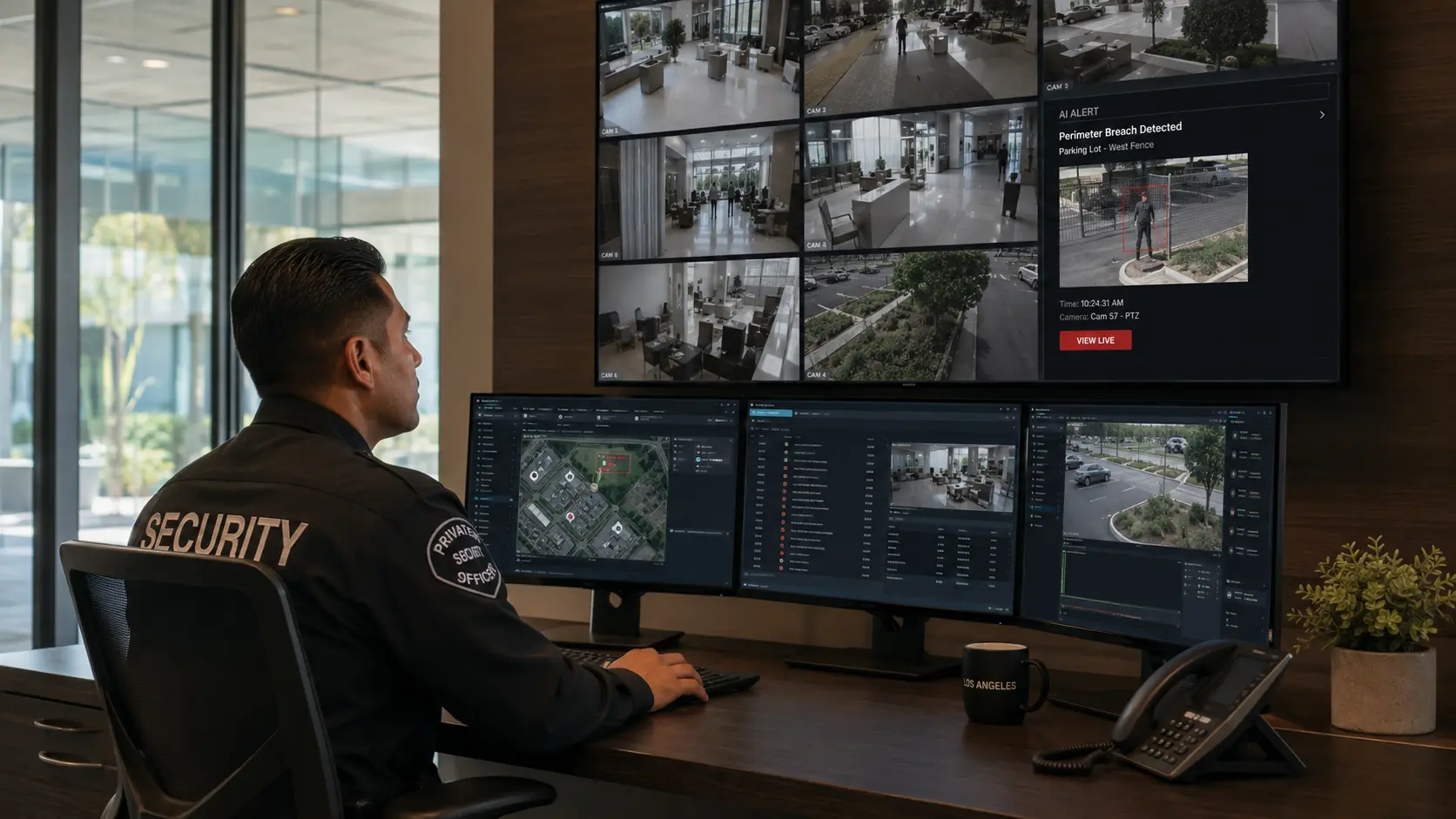
With AI-assisted monitoring, the system can flag potentially significant events.
The workflow becomes:
AI detects → guard verifies → guard assesses → guard responds.
This can potentially reduce the amount of time guards spend on routine observation and allow them to concentrate on situations where human judgment matters.
AI can improve surveillance efficiency.
One of the biggest advantages of AI is continuous monitoring.
A human guard can become tired, distracted, or overwhelmed by multiple simultaneous events.
An automated system can continuously analyze video and sensor data according to its programmed capabilities.
That does not make AI infallible.
It does mean that AI can provide a consistent first layer of detection across large amounts of data.
For a property with extensive surveillance coverage, this can be particularly useful.
Instead of reviewing hours of footage after an incident, security personnel may be able to search for specific events or receive alerts when a relevant condition is detected.
AI can help reduce alarm fatigue.
Security professionals frequently deal with large numbers of alerts.
If too many alarms are generated and most turn out to be irrelevant, operators can become desensitized to them.
This is commonly referred to as alarm fatigue.
AI can potentially help prioritize alerts by analyzing multiple data points and identifying events that deserve greater attention.
For example, a system might distinguish between ordinary activity and activity that occurs under unusual conditions.
The exact capabilities depend heavily on the technology and how it is configured.
The important point is that AI can potentially help security teams move from responding to every alert equally toward prioritizing the events most likely to matter.
Can AI prevent crime?
AI can contribute to crime prevention, but businesses should be careful about making absolute claims.
Technology can improve detection, increase surveillance coverage, identify certain patterns, and help security personnel respond more quickly.
Visible security cameras and AI-enabled monitoring may also contribute to deterrence.
But no technology can guarantee that a crime will not occur.
An AI system may fail to detect an event.
A detected event may be misinterpreted.
A guard may be unable to respond immediately.
A determined offender may adapt to the security system.
Security is therefore best understood as risk reduction, not perfect prevention.
AI can be particularly useful for large properties
The value of AI often increases as the physical environment becomes larger or more complex.
Consider:
- Shopping centers
- Warehouses
- Distribution facilities
- Construction sites
- Apartment communities
- Parking facilities
- Industrial properties
- Office campuses
- Hotels
- Hospitals
- Large commercial buildings
These environments may contain multiple entrances, large outdoor areas, numerous cameras, and substantial amounts of activity.
AI can help security teams manage the resulting volume of information.
But physical presence may remain necessary.
A camera can identify a person entering a restricted area.
A security guard can go there.
That distinction is fundamental.
What are the threats associated with AI in private security?
AI is not risk-free.
Businesses considering AI-enabled security should understand the potential downsides before implementation.
Major concerns include:
- False positives
- False negatives
- Privacy
- Data security
- System reliability
- Bias and inaccurate classification
- Overreliance on automation
- Cybersecurity vulnerabilities
- Poor system configuration
- Lack of human oversight
- Vendor dependence
- Inadequate employee training
The presence of AI does not automatically make a security operation better.
Poorly implemented AI can make an operation more complicated—or create a false sense of security.
What happens when AI gets an alert wrong?
This is one of the most important questions businesses should ask.
Imagine an AI camera identifies a person as behaving suspiciously.
The system generates an alert.
If the business treats the automated classification as proof that the person committed a crime, a relatively ordinary situation could escalate unnecessarily.
AI should therefore generally be treated as an information source, not an unquestionable authority.
A trained security professional can evaluate the surrounding circumstances.
The person may be authorized to be there.
The camera angle may be misleading.
The system may have misunderstood ordinary behavior.
The alert could simply be wrong.
Human verification is particularly important when an AI-generated alert could lead to someone being detained, removed from a property, or reported to law enforcement.
Can AI replace human judgment?
AI can support decision-making, but it should not automatically replace human judgment in situations involving significant consequences.
Security incidents frequently contain context that cannot be reduced to a simple classification.
For example, an AI system might detect two people moving rapidly toward one another.
Is it:
- A fight?
- A game?
- Someone running to help another person?
- A medical emergency?
- A security incident?
The software may identify movement.
A human can investigate the context.
That is why the strongest AI security models generally treat artificial intelligence as a decision-support layer, while leaving consequential decisions to trained personnel.
What happens when AI fails?
Every technology system can fail.
Power can be interrupted.
Networks can go down.
Cameras can malfunction.
Software can produce errors.
Sensors can become obstructed.
Cloud services can become unavailable.
Cyberattacks can disrupt systems.
A professional security plan therefore needs a fallback procedure.
Businesses should ask:
What happens if the AI system stops working at 2 a.m.?
If the answer is “nothing,” the security system is dangerously dependent on technology.
Human guards can provide an important layer of resilience during technology failures.
Does AI reduce the need for security guards?
It can reduce the need for certain types of security labor.
This is an important reality that businesses should not ignore.
If AI can automate a substantial amount of repetitive camera monitoring, a company may determine that fewer human monitoring hours are necessary.
However, reducing monitoring labor does not necessarily mean eliminating physical security personnel.
The remaining guards may perform different and potentially more valuable duties.
Instead of spending most of a shift watching cameras, a guard might:
- Respond to AI-generated alerts
- Conduct physical patrols
- Manage access control
- Assist employees
- Investigate incidents
- De-escalate conflicts
- Respond to emergencies
- Coordinate with first responders
- Protect vulnerable areas
- Document incidents
AI can therefore change the composition of a security job without eliminating the need for human security.
AI may change the skills security guards need
As security technology becomes more sophisticated, technology literacy may become increasingly important for security professionals.
A modern guard may need to understand:
- Digital surveillance systems
- AI-generated alerts
- Access-control software
- Mobile security applications
- Radio and communications systems
- Incident-management platforms
- Digital reporting
- CCTV review
- Basic cybersecurity awareness
But technical knowledge should complement—not replace—traditional security skills.
Communication, observation, situational awareness, de-escalation, professionalism, and emergency response remain important.
The security professional of the future may need to be both a people-focused responder and a technology-aware operator.
Could AI make guards less attentive?
Yes, and this is an underappreciated risk.
If security personnel become overly dependent on automated alerts, they may gradually stop looking for things that the system does not identify.
This can create a dangerous assumption:
“If AI didn’t alert me, nothing happened.”
That is not necessarily true.
AI systems are designed around particular detection capabilities. An event outside those capabilities may never generate an alert.
Security professionals therefore still need to maintain situational awareness.
AI should expand a guard’s awareness—not replace it.
AI and privacy
AI-powered surveillance can raise privacy concerns that traditional security cameras did not raise to the same degree.
A conventional camera records what happens in front of it.
An intelligent system may analyze that footage, classify activity, identify patterns, or connect information across multiple systems.
Depending on the technology, businesses may also process information relating to people, vehicles, access credentials, or other potentially sensitive data.
Businesses should therefore understand:
- What data the system collects
- What the system analyzes
- Where information is stored
- How long it is retained
- Who can access it
- Whether it is shared
- How it is secured
- What laws and regulations apply
A business should not deploy AI surveillance without considering the privacy implications.
AI creates cybersecurity considerations.
The more connected a security system becomes, the more important cybersecurity becomes.
AI cameras, access-control systems, cloud dashboards, mobile applications, and remote-monitoring platforms can all become part of a business’s technology infrastructure.
A compromise of that infrastructure could potentially affect physical security.
For example, an attacker who gains unauthorized access to a security system might attempt to:
- Disable cameras
- Manipulate alerts
- Access surveillance footage
- Obtain sensitive information
- Disrupt access-control systems
- Target connected devices
Physical security and cybersecurity are increasingly interconnected.
Businesses should therefore evaluate the security of the technology itself—not simply what the technology is capable of detecting.
Should AI make security decisions automatically?
For low-risk administrative tasks, automation can be extremely useful.
For high-consequence decisions, businesses should be much more cautious.
There is a significant difference between:
“AI detected movement in a restricted area.”
and:
“AI determined that this person committed a crime.”
The first is an alert.
The second is a consequential judgment.
Security systems should be designed so that the level of human oversight reflects the consequences of the decision.
When an automated system’s output could lead to detention, removal, disciplinary action, or law-enforcement involvement, human verification becomes especially important.
AI does not understand every situation the way people do
Artificial intelligence can identify patterns extremely quickly, but human environments are messy.
People behave unpredictably.
Security incidents rarely occur exactly according to a predefined script.
A person may be injured.
A customer may become confused.
An employee may make a mistake.
A visitor may enter an area accidentally.
Two people may be arguing without becoming violent.
An emergency may develop that was never included in the AI system’s training or detection rules.
Human security professionals can adapt to circumstances that were not anticipated by the software.
That adaptability is one of the strongest arguments for maintaining a human component in private security.
AI can improve incident investigations
AI is not limited to real-time monitoring.
It can also help security personnel investigate incidents after they occur.
Instead of manually searching through hours of surveillance footage, intelligent video systems may allow operators to search for particular characteristics or events.
For example, investigators may be able to narrow footage by:
- Time
- Location
- Camera
- Object type
- Direction of movement
- Vehicle activity
- Other system-supported characteristics
This can potentially reduce investigation time and help security teams identify relevant footage more efficiently.
The results should still be verified by a human.
An AI search result is not automatically proof of what happened.
AI can help security managers identify patterns
Another potential advantage is long-term analysis.
A security manager can examine incident information to identify recurring patterns.
For example:
- Which entrances experience the most incidents?
- What times generate the most alarms?
- Which areas repeatedly experience unauthorized access?
- When do theft incidents increase?
- Are particular types of incidents occurring repeatedly?
AI and data analytics can help turn large quantities of security information into actionable patterns.
That can allow management to change staffing, patrol schedules, access controls, lighting, surveillance coverage, or other security measures.
AI is most valuable when paired with good security fundamentals
Technology cannot compensate for a poorly designed security program.
A business may purchase expensive AI surveillance and still have weak security if:
- Cameras are poorly positioned
- Guards are inadequately trained
- Post orders are unclear
- Access controls are poorly managed
- Alerts are ignored
- Incident reports are incomplete
- Employees do not know emergency procedures
- No one maintains the technology
- There is no response plan
AI should therefore be considered one component of a broader security strategy.
The fundamentals still matter.
What should businesses ask before adopting AI security?
Before investing in an AI-enabled security system, businesses should ask practical questions rather than focusing only on marketing claims.
What problem are we trying to solve?
A technology solution should begin with a security problem.
If the problem is unauthorized after-hours access, the business may need intelligent intrusion detection.
If the problem is retail theft, video analytics may help.
If the problem is a lack of physical response, cameras alone will not solve it.
What happens after an alert?
An alert without a response process has limited value.
Businesses should determine who receives alerts, who verifies them, how quickly someone responds, and what happens if the initial responder cannot address the incident.
How accurate is the system in our environment?
A system that performs well in a controlled demonstration may perform differently in a particular property.
Businesses should evaluate performance in their actual environment.
What happens when the technology fails?
A security program needs a backup plan.
Who is responsible for the system?
Someone should be responsible for configuration, maintenance, updates, access control, and performance monitoring.
What information does the system collect?
Businesses should understand the privacy and data implications before deployment.
Is AI a threat to private security jobs?
It can be for certain roles.
Security jobs centered heavily on repetitive monitoring are more exposed to automation than jobs involving physical presence, judgment, communication, and incident response.
But the broader effect may be more complicated than simple job elimination.
Technology has historically changed the responsibilities associated with security work.
The guard’s role can evolve from:
Monitor everything manually
to:
Monitor intelligent systems, verify alerts, respond to incidents, and manage the physical environment.
That requires a different skill set.
For security professionals, learning to work effectively with technology may therefore become an important career advantage.
Is AI a force multiplier?
In the right environment, yes.
A force multiplier is something that allows a person or team to accomplish more than they could accomplish with the same resources alone.
AI can potentially do this by:
- Monitoring large amounts of data
- Identifying anomalies
- Prioritizing alerts
- Accelerating video searches
- Supporting situational awareness
- Reducing repetitive monitoring
- Providing additional information to security personnel
But AI becomes a force multiplier only when the surrounding security operation is capable of responding to what the technology identifies.
A system that generates hundreds of alerts that nobody can investigate is not a force multiplier.
It is an additional workload.
The strongest model is human-led, technology-assisted security
The most practical approach for many businesses is neither complete automation nor complete reliance on traditional methods.
It is a layered model.
Technology provides:
- Continuous monitoring
- Data processing
- Automated detection
- Alerts
- Analytics
- Video search
- Access-control intelligence
Security professionals provide:
- Human judgment
- Physical presence
- Communication
- De-escalation
- Investigation
- Emergency response
- Decision-making
- Accountability
This division of responsibilities recognizes the strengths and limitations of both.
AI is exceptionally good at processing information.
People remain essential for understanding context and taking action in the physical world.
What does this mean for Los Angeles businesses?
For businesses in Los Angeles, AI can be particularly useful when integrated with an existing security operation.
A retail property might use AI video analytics to identify potentially suspicious activity while guards focus on customer safety, loss prevention, and incident response.
A construction site might combine surveillance, perimeter sensors, and AI alerts with mobile patrols.
An office building might use intelligent access control while maintaining a security professional in the lobby.
A large commercial property might use centralized monitoring to support guards working across multiple areas.
The appropriate solution depends on the property and its risks.
There is no universal AI security package that will work equally well for every business.
The bottom line
AI is neither automatically a threat nor automatically a solution for private security.
It is a technology that can change how security operations work.
Used properly, AI can help security professionals process more information, detect potential incidents faster, reduce repetitive monitoring, improve investigations, and focus human attention where it matters most.
Used poorly, it can create false confidence, generate unnecessary alerts, introduce privacy and cybersecurity risks, and encourage businesses to reduce human security coverage without adequately replacing the functions those guards performed.
The most effective approach is therefore not:
“AI or security guards?”
It is:
“Where can AI make security professionals more effective?”
For many businesses, the answer will be a combination of intelligent technology and trained human personnel.
AI can detect.
AI can analyze.
AI can prioritize.
But when a real person needs help, a conflict needs to be de-escalated, an emergency needs to be managed, or someone needs to respond physically to an incident, human security professionals remain an essential part of the equation.