📩 info@irisprotectionservices.com 📲 (657) 214-0877 🏛️ Iris Protection Services, Inc 🛂 License No. PPO120833

Will AI Replace Security Guards? The Reality for U.S. Private Security
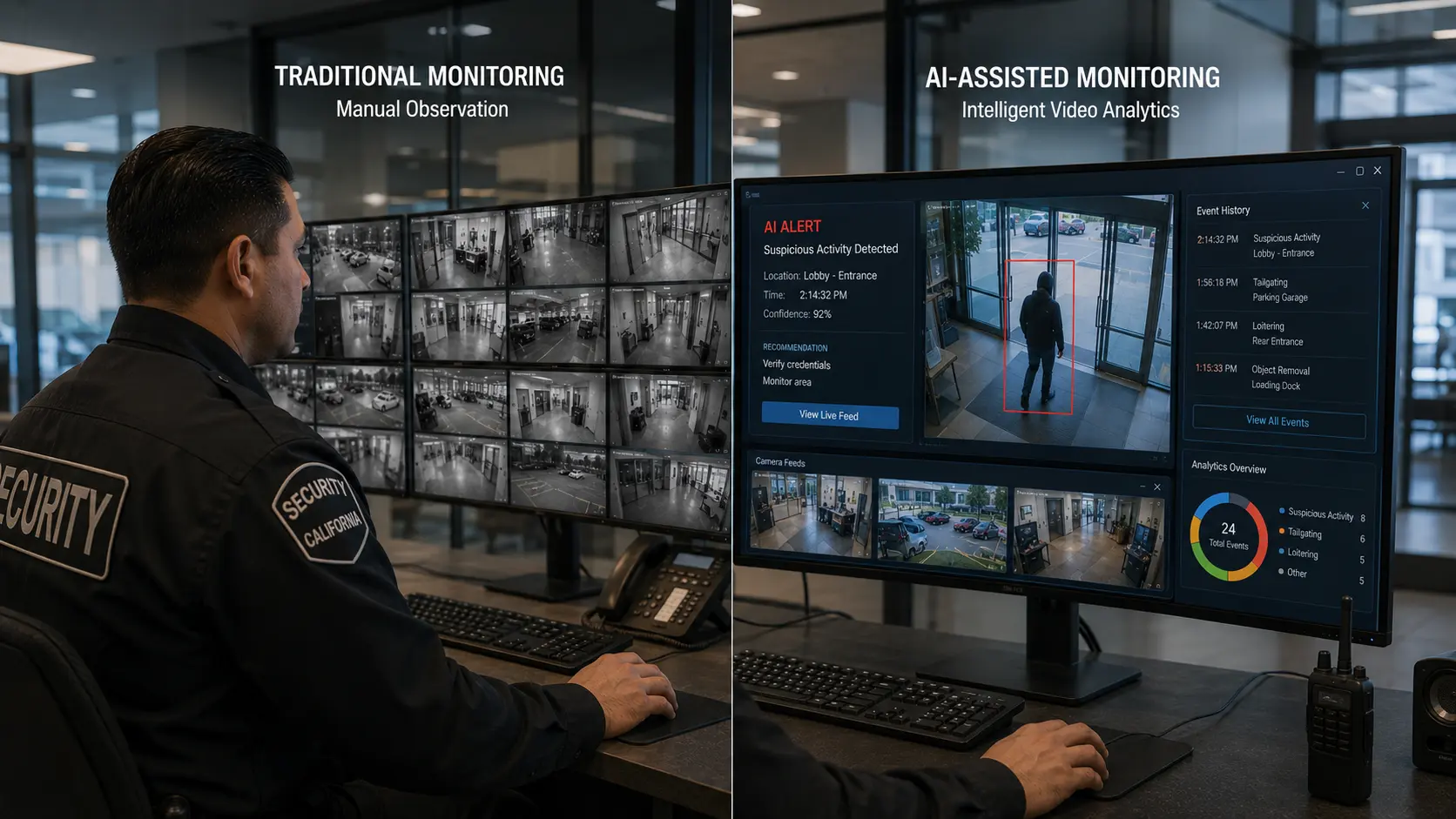
Artificial intelligence is changing the way businesses approach security.
Modern security systems can analyze video feeds, detect unusual activity, identify certain objects or events, automate alerts, monitor access-control systems, and help security teams prioritize incidents. Some facilities are also experimenting with autonomous patrol robots, drones, remote monitoring, and increasingly sophisticated analytics.
That naturally raises an important question:
Will AI eventually replace security guards?
The most realistic answer is no—not security guards as a whole. But AI is likely to change the security guard profession significantly.
Some tasks traditionally performed by guards can already be supplemented or partially automated by technology. A camera system can watch an area continuously. Software can flag activity that might otherwise be missed. Access-control systems can automatically verify credentials. Remote operators can monitor multiple locations from a centralized facility.
At the same time, technology cannot simply replace every function performed by a trained security professional.
A human guard can communicate with a visitor, recognize context that an automated system may misunderstand, de-escalate a conflict, respond physically to an emergency, assist an injured person, enforce property rules, coordinate with employees, and make judgment calls in situations that do not fit neatly into a software-defined event.
The future of private security is therefore less likely to be AI versus guards and more likely to be AI working alongside guards.
Is AI already being used in private security?
Yes.
AI is no longer merely a future concept for the security industry.
Security organizations are already using artificial intelligence and machine-learning technologies in areas such as video analytics, surveillance, access control, anomaly detection, and security operations.
ASIS International’s security research has highlighted the industry’s growing use of AI. Its research found that most surveyed security professionals reported that their organizations were already using AI in some capacity. Security systems are particularly suited to AI because cameras, access-control systems, sensors, and other technologies generate enormous amounts of data that humans cannot continuously analyze on their own.
The Security Industry Association has likewise described AI as increasingly integrated into physical-security platforms and analytics systems, rather than as a distant technology that the industry is merely considering.
For businesses, this means AI-enabled security is already becoming part of the available technology landscape.
What can AI do in security?
AI can perform or assist with many tasks that traditionally required substantial human attention.
Depending on the system, AI-powered security technology can help with:
- Video monitoring
- Object detection
- Intrusion detection
- Perimeter monitoring
- Unusual-activity detection
- Access-control monitoring
- License-plate recognition
- Crowd analysis
- Occupancy monitoring
- Alarm verification
- Incident prioritization
- Video search
- Automated notifications
- Security reporting
- Remote monitoring
- Pattern and anomaly detection
The important distinction is that detecting an event is not the same as responding to it.
An AI system may identify a person entering a restricted area. A human security professional may still need to determine why the person is there, communicate with the individual, verify authorization, assess the circumstances, and decide what action is appropriate.
That distinction explains why AI can be extremely useful without eliminating the need for human security personnel.
Can AI cameras replace security guards?
AI-enabled cameras can replace some guard functions, but that is different from replacing guards entirely.
Traditional CCTV systems generally require people to watch screens or review recordings.
AI-enabled video analytics can help automate portions of that process by identifying activity that meets specified criteria and bringing it to an operator’s attention.
Instead of a security professional staring continuously at dozens of camera feeds, an AI system can potentially act as a first layer of detection.
This can make security operations more efficient.
But an alert is only the beginning of an incident response.
Consider a camera that detects someone entering a restricted area after hours.
The system may identify the movement and generate an alert.
A human still may need to determine:
- Who is the person?
- Are they authorized to be there?
- Did they enter accidentally?
- Is there an emergency?
- Is the person committing a crime?
- Is anyone in danger?
- Should the person be contacted?
- Should law enforcement be notified?
- Should another guard be dispatched?
AI can help answer some of these questions, but it does not automatically eliminate the need for human judgment.
Will AI eliminate overnight security guards?
This is one area where automation could have a meaningful effect.
A business that currently pays a guard primarily to monitor cameras, watch a quiet perimeter, or respond to routine alarms may increasingly consider technology-assisted or remote monitoring.
AI can continuously analyze cameras and sensors without breaks, sleep, or distraction.
For properties where the security requirement is primarily detection and notification, technology may therefore reduce the number of hours of human monitoring required.
But many properties need more than detection.
A guard who is physically present can investigate an unusual situation, speak to employees, escort someone from a property, provide directions, respond to emergencies, call for medical assistance, secure an area, or assist law enforcement.
The more a security assignment depends on physical presence and human interaction, the harder it is to replace with software alone.
What does the U.S. job outlook say?
The employment data provide a useful reality check against extreme predictions about AI eliminating security jobs.
The U.S. Bureau of Labor Statistics currently projects approximately 1.29 million security-guard jobs in 2025 and about 1.31 million in 2035, representing roughly 1% employment growth over the period. BLS also projects approximately 157,200 openings per year for security guards and gambling surveillance officers, largely because workers leave the occupation or move into other jobs.
At the same time, BLS explicitly recognizes technology as a factor that may limit demand for security guards.
In other words, the government employment outlook does not support either extreme:
“AI will eliminate security guards.”
Nor does it support:
“Technology will have no effect on security jobs.”
The more reasonable interpretation is that technology is likely to reduce or reshape demand for some types of security work while substantial demand for human security personnel remains.
Which security jobs are most vulnerable to automation?
Not all security assignments are equally exposed to AI and automation.
Jobs are generally more vulnerable when the primary duties involve repetitive monitoring or predictable tasks that technology can perform continuously.
Examples may include assignments heavily focused on:
- Watching CCTV screens
- Monitoring alarms
- Checking routine access events
- Performing predictable patrols
- Recording repetitive observations
- Generating basic incident reports
- Monitoring restricted areas with limited human interaction
These functions can increasingly be supported by AI, sensors, automation, and centralized monitoring.
This does not necessarily mean that the guard disappears.
Instead, the number of guards, the amount of monitoring required, or the amount of time a guard spends on these particular tasks may change.
Which security jobs are harder to replace?
Security work becomes more difficult to automate when it requires physical presence, judgment, communication, adaptability, or interpersonal skills.
Human guards remain particularly valuable when assignments involve:
- Access control
- Customer interaction
- Conflict de-escalation
- Emergency response
- Workplace violence prevention
- Construction-site security
- Retail loss prevention
- Executive protection
- Residential security
- Hospital security
- Event security
- Mobile patrols
- Physical intervention
- Visitor management
- Incident investigation
- Coordination with police, fire, or emergency medical services
A software system can identify a potential problem.
A person can walk toward the problem and deal with the people involved.
That difference remains fundamental.
Can an AI system de-escalate a confrontation?
AI can assist with communication and provide information, but physical-world conflict remains particularly difficult to automate safely.
Imagine a disagreement between two customers in a retail store.
A camera might identify unusual movement or a possible physical confrontation.
But determining what is actually happening can require context.
Is it a fight?
Is one person helping another who has fallen?
Is someone experiencing a medical emergency?
Are two employees responding to an emergency?
Are they arguing, joking, or actually becoming violent?
A trained security professional can approach, communicate, assess the situation, and adjust their response based on what happens next.
That human adaptability is one of the strongest reasons that AI is more likely to augment security guards than completely replace them.
Can AI physically respond to an incident?
This is where the difference between software and physical security becomes especially important.
An AI system can generate an alert.
A camera can identify an event.
A remote operator can communicate with someone through a speaker.
A robotic system may be capable of moving through a facility.
But most businesses still need humans when an incident requires physical intervention, assistance, evacuation, first aid, customer support, access control, or direct coordination with people at the location.
Even highly automated security environments therefore need to consider what happens after detection.
A security program that can detect ten times as many incidents but has nobody capable of responding to those incidents may not actually provide better protection.
Will security robots replace guards?
Security robots are attracting attention because they can perform certain repetitive tasks.
Depending on the technology and environment, autonomous or semi-autonomous systems can potentially patrol defined areas, provide surveillance, detect certain conditions, and communicate alerts.
But robots face practical limitations.
They operate within physical environments that can be unpredictable.
Stairs, crowds, weather, blocked paths, construction activity, elevators, vehicles, pets, children, and unexpected human behavior can complicate autonomous operation.
There is also a major difference between patrolling an area and handling an incident.
A robot may be able to identify something unusual.
A human guard may still be needed to determine what it means and what to do next.
For this reason, robotic systems are more likely to become another layer of a security program than an immediate replacement for the entire human workforce.
What about drones?
Drones can extend the reach of a security operation, particularly for large properties.
They may be useful for:
- Perimeter observation
- Construction sites
- Industrial facilities
- Large outdoor properties
- Infrastructure inspection
- Remote-area monitoring
- Situational awareness
But drones also involve operational, regulatory, privacy, safety, and environmental considerations.
A drone can provide an aerial view, but it does not automatically replace the need for someone to interpret what is happening on the ground.
Businesses considering drone-based security should therefore treat the technology as part of an overall security system rather than assuming that an aircraft can replace every physical-security function.
Does AI make security guards less important?
Not necessarily.
It may make certain guard tasks less important.
That is an important distinction.
If a guard spends most of a shift staring at surveillance screens waiting for something unusual to happen, AI could make that process considerably more efficient.
Instead of replacing the entire guard, the business might use AI to allow the guard to spend more time on activities that require human judgment.
For example:
Traditional model:
Guard watches 40 camera feeds → notices possible incident → investigates.
AI-assisted model:
AI analyzes camera feeds → flags unusual event → guard investigates → guard communicates with people involved → guard documents and escalates incident if necessary.
The second model can potentially make the guard more effective, not obsolete.
AI may change what businesses expect from guards.
As technology takes over more repetitive monitoring tasks, employers may increasingly value security professionals who can perform higher-level responsibilities.
Future-oriented security guards may need stronger skills in:
- Technology operation
- Video analytics
- Access-control systems
- Incident management
- Report writing
- Communication
- De-escalation
- Emergency response
- Customer service
- Evidence preservation
- Radio communication
- Situational awareness
In other words, the guard of the future may spend less time simply watching and more time interpreting, responding, communicating, and managing incidents.
The Security Industry Association has made a similar point in its recent discussion of AI in physical security: rather than simply automating existing workflows, organizations can use AI to help identify meaningful events and allow humans to focus on investigation, decisions, and response.
Will AI reduce the number of security guards businesses hire?
For some businesses, potentially yes.
If technology can reliably perform part of an existing security assignment, a business may decide that it needs fewer human hours.
For example, a facility that previously required continuous manual video monitoring may move toward AI-assisted remote monitoring.
A property that previously required routine patrols might supplement those patrols with sensors, cameras, and automated alerts.
These changes can reduce labor requirements for certain assignments.
But cost is only one factor.
Businesses also have to consider:
- The value of physical presence
- Response times
- Liability
- Customer experience
- Employee safety
- Property layout
- Crime risk
- Insurance requirements
- Regulatory requirements
- System reliability
- Cybersecurity
- Privacy
- The consequences of missed detections
A cheaper security system is not necessarily a better security system.
Can AI make mistakes?
Yes.
This is one of the most important realities businesses should understand.
AI systems do not possess a perfect understanding of the physical world.
They can produce false positives, false negatives, classification errors, and other mistakes.
A system might flag harmless behavior as suspicious.
It might fail to recognize an actual threat.
Lighting, camera position, weather, occlusion, crowds, unusual behavior, equipment failures, and other factors can affect performance.
That is why responsible security design should not assume that an AI alert is automatically true.
A human security professional can provide an additional layer of verification.
What happens when AI gets an alert wrong?
Suppose an AI system incorrectly identifies a customer as a potential shoplifter.
If the business has designed its system so that an automated alert immediately triggers an aggressive intervention, the technology could contribute to a serious incident.
A better approach is often to use AI as an alerting and decision-support tool rather than treating every automated conclusion as fact.
A security guard can verify the situation before taking action.
This human verification layer can be particularly important when an incident could result in someone being detained, removed from a property, or reported to law enforcement.
Does AI create privacy concerns?
Yes.
AI-enabled security can involve significantly more data collection and analysis than traditional surveillance.
Depending on the technology, systems may analyze video, vehicle information, access records, biometric information, or other sensitive data.
Businesses should therefore consider privacy and data-governance requirements when deploying AI-enabled security systems.
Questions worth asking include:
- What information is being collected?
- Why is it being collected?
- How long is it retained?
- Who can access it?
- Where is it stored?
- Is it shared with third parties?
- How is access controlled?
- What happens if the system is compromised?
- What legal requirements apply to the particular technology and location?
AI can make surveillance more powerful, but greater capability also creates greater responsibility.
Can AI be hacked?
AI-enabled security systems are still technology systems, and technology systems can create cybersecurity risks.
Connected cameras, access-control systems, cloud platforms, sensors, mobile applications, and remote-monitoring infrastructure all need appropriate cybersecurity controls.
A business should therefore consider physical security and cybersecurity together.
A sophisticated AI camera system is not particularly useful if an attacker can disable it, access its data, manipulate alerts, or compromise the network supporting it.
Modern security increasingly requires both physical protection and technological resilience.
Is a human security guard still worth paying for?
For many businesses, yes.
The answer depends on what the business actually needs security personnel to accomplish.
If a business needs only basic video monitoring, technology may be able to handle a larger portion of the workload.
But if the business needs someone physically present to:
- Monitor entrances
- Verify visitors
- Respond to alarms
- Assist employees
- Deter theft
- Handle disturbances
- Patrol a property
- Respond to emergencies
- Coordinate with first responders
- Protect people
- Enforce site procedures
Then a human guard provides capabilities that a software platform cannot fully duplicate.
The correct question is therefore not:
“Can AI replace a security guard?”
A better question is:
“Which security tasks should be automated, and which require a human?”
The future is likely to be hybrid security.
The most practical model for many businesses will be a combination of technology and human personnel.
A security operation might look like this:
AI and technology
- Monitor cameras
- Analyze video
- Detect anomalies
- Monitor access control
- Generate alerts
- Track alarms
- Search video
- Provide data
Human security professionals
- Verify incidents
- Respond physically
- Communicate with people
- De-escalate conflicts
- Make decisions
- Assist customers and employees
- Conduct patrols
- Manage emergencies
- Coordinate with authorities
- Document incidents
This division of responsibilities allows each side to do what it does best.
Technology is excellent at continuous monitoring and data processing.
People are better suited to context, judgment, communication, physical response, and accountability.
What does this mean for Los Angeles businesses?
For businesses in Los Angeles, AI-assisted security is likely to become increasingly common.
Retail stores, apartment communities, office buildings, warehouses, construction sites, parking facilities, and other commercial properties can use technology to improve visibility and identify potential problems.
But technology should be selected according to the actual security risk.
A large construction site may need physical patrols.
A retail store may benefit from a combination of guards and AI video analytics.
An office building may use access control and visitor-management technology while maintaining a security professional in the lobby.
A warehouse may combine cameras, intrusion detection, access control, and mobile patrols.
There is no single technology solution that fits every property.
Should businesses replace guards with AI?
In most cases, businesses should not approach the decision as a simple replacement exercise.
Instead, they should evaluate the entire security operation.
Ask:
- What threats are we trying to prevent?
- What can technology reliably detect?
- What requires a human response?
- How quickly must someone respond?
- What happens when the technology fails?
- Who verifies AI-generated alerts?
- What are the privacy implications?
- What happens during a power or network outage?
- What level of physical presence does the property require?
- Would reducing guard coverage create unacceptable risk?
The right answer may be more technology, more guards, fewer guards, different guard duties, or some combination of all three.
Will AI replace security guards? The bottom line
AI will replace some security tasks. It is unlikely to replace security guards altogether.
The U.S. private-security industry is already adopting AI, advanced surveillance, analytics, and automation. Some repetitive monitoring functions will become increasingly automated, and certain security assignments may require fewer human hours as technology improves. The BLS outlook reflects this possibility while still projecting continued employment for more than a million U.S. security guards through the next decade.
The bigger change may be in what security guards do.
The traditional guard who spends an entire shift watching cameras or performing repetitive checks may become less common.
The technology-enabled guard who monitors intelligent systems, verifies alerts, responds to incidents, communicates with people, manages emergencies, and makes judgment calls may become more valuable.
For businesses, the future of private security is therefore unlikely to be humans versus machines.
It is more likely to be:
AI detects.
Humans decide.
Technology informs.
Security professionals respond.
The businesses that get the best results will not necessarily be those that automate the most. They will be the ones that understand which parts of security can be automated safely—and where a trained human being is still the most important security asset on the property.
Frequently Asked Questions
Will AI replace security guards in the United States?
AI is likely to automate some security tasks and may reduce demand for certain monitoring-heavy roles, but current U.S. employment projections do not indicate that security guards as an occupation are disappearing. BLS projects about 1% growth in security-guard employment from 2025 to 2035.
Can AI replace a security guard completely?
For certain narrowly defined tasks, technology may replace some human labor. However, a complete replacement depends on the property, threat environment, required response, and the ability of technology to handle physical and interpersonal situations.
What security tasks can AI automate?
AI can assist with video monitoring, anomaly detection, access-control monitoring, alarm verification, surveillance analysis, video search, and other repetitive data-intensive tasks.
Will AI reduce security guard jobs?
It may reduce demand for some types of security work, particularly assignments dominated by repetitive monitoring. BLS specifically notes that increased use of surveillance technology is expected to somewhat limit demand for security guards.
Are security guards still necessary with AI cameras?
Often, yes. AI cameras can detect and report potential incidents, but a human may still be needed to verify the event, communicate with people, respond physically, make decisions, and coordinate with emergency services.
Can AI detect a crime?
AI systems can detect patterns or events associated with potential security incidents, but detecting an event is not necessarily the same as determining that a crime has occurred. Human verification and appropriate procedures remain important.
Are AI security systems more reliable than human guards?
Neither is perfect. AI can continuously monitor large amounts of data but can make classification and detection errors. Human guards can understand context and respond flexibly but can also become distracted, fatigued, or miss events. Combining both can provide complementary strengths.
Will security guards need new skills because of AI?
Increasingly, yes. Guards who can operate security technology, interpret alerts, communicate effectively, document incidents, and respond to complex situations may become more valuable as automation handles more repetitive monitoring work.
Should my business replace security guards with AI?
Not automatically. Businesses should first identify their security risks and determine which functions technology can reliably perform. A security assessment can help determine the appropriate combination of guards, cameras, access control, remote monitoring, sensors, and other technologies.
What is the future of private security?
The private-security industry is likely to become increasingly technology-enabled. AI, video analytics, access control, remote monitoring, sensors, and other technologies will handle more detection and data-processing tasks, while human security professionals remain important for physical presence, judgment, communication, response, and incident management.