📩 info@irisprotectionservices.com 📲 (310) 766-5927 🏛️ Iris Protection Services, Inc 🛂 License No. PPO120833

Security Guards vs. Surveillance Systems: Which Is More Effective?
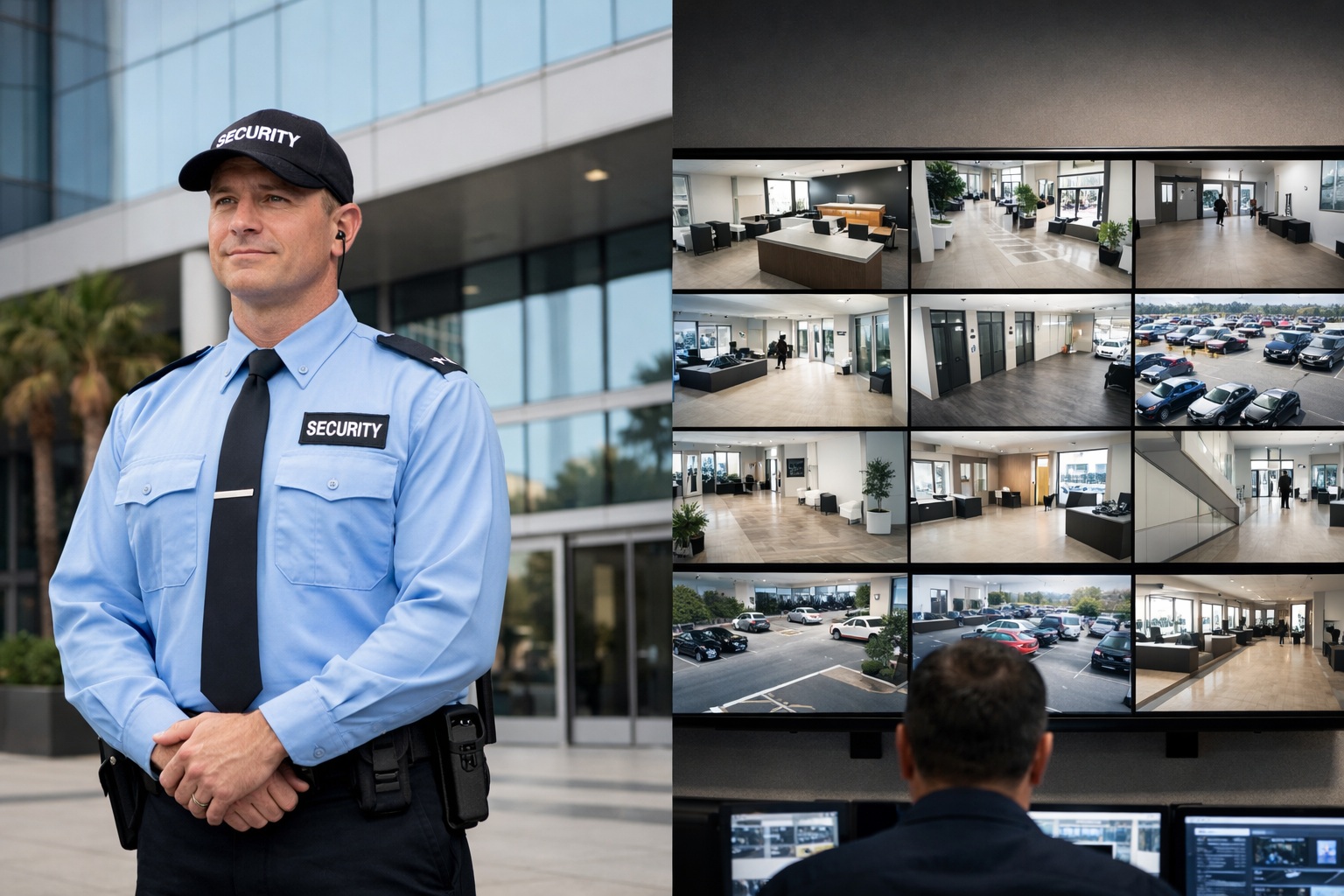
Business security planning often involves a fundamental question: Is it more effective to invest in professional security guards or surveillance systems?
The answer is rarely absolute. Both solutions serve distinct operational purposes, and effectiveness depends on the type of risk, environment, and response requirements involved. This article provides a neutral, structured comparison to help businesses make informed decisions based on measurable factors rather than assumptions.
Understanding the Core Difference
At a functional level:
- Security guards provide active, human presence and real-time response.
- Surveillance systems provide monitoring, recording, and documentation.
The distinction is important. Guards intervene. Cameras observe.
The Role of Security Guards
Professional security guards perform a range of protective functions, including:
- Visible crime deterrence
- Access control
- Patrol and perimeter monitoring
- Immediate response to incidents
- Conflict de-escalation
- Emergency coordination
- Detailed incident reporting
Their presence can discourage theft, trespassing, vandalism, and workplace disruptions before they escalate.
Strengths of Security Guards
- Immediate Response Capability
Guards can act in real time rather than merely recording events. - Adaptability
Human judgment allows a response to unexpected or evolving situations. - De-escalation Skills
Trained guards can manage confrontations without force. - Customer Interaction
In many environments, guards assist visitors and employees.
Limitations
- Higher recurring operational cost
- Performance varies based on training and supervision
- Limited coverage area per individual
The Role of Surveillance Systems
Surveillance systems include:
- CCTV cameras
- Remote monitoring systems
- Motion detection
- Access control integration
- Video recording and storage
They provide continuous monitoring and documentation across wide areas.
Strengths of Surveillance Systems
- 24/7 Coverage
Cameras can operate continuously without fatigue. - Wide Area Monitoring
A single system can monitor multiple entry points simultaneously. - Evidence Collection
Recorded footage supports investigations and insurance claims. - Lower Long-Term Operating Costs
After installation, maintenance costs are generally lower than staffing.
Limitations
- Cannot physically intervene
- Depend on monitoring for real-time effectiveness
- Vulnerable to blind spots or technical failure
- Limited deterrence in some environments
Cameras primarily document incidents. They do not stop them unless paired with response mechanisms.
Comparing Effectiveness by Scenario
Effectiveness depends on the risk profile and operational needs of the business.
1. Retail Stores
- Cameras help monitor shoplifting patterns.
- Guards deter theft and can intervene immediately.
In high-theft environments, guards often provide stronger deterrence.
2. Construction Sites
- Cameras monitor perimeter breaches.
- Guards conduct patrols and respond to trespassers.
For high-value equipment sites, a combination is often most effective.
3. Office Buildings
- Access control systems manage entry credentials.
- Guards verify visitors and maintain lobby oversight.
Customer-facing environments often benefit from human presence.
4. Warehouses & Industrial Facilities
- Surveillance systems monitor loading docks.
- Guards respond to alarms and coordinate emergency actions.
Layered security improves overall effectiveness.
Cost Considerations
From a financial perspective:
- Surveillance systems involve upfront capital expenditure (equipment, installation).
- Security guards involve recurring operational expenses (wages, insurance, compliance).
However, cost should be evaluated against:
- Asset value
- Crime risk
- Liability exposure
- Business interruption impact
Lower upfront cost does not necessarily equal better protection.
Deterrence vs. Documentation
One of the most important distinctions is this:
- Security guards primarily deter and respond.
- Surveillance systems primarily record and review.
If the goal is to prevent incidents, visible human presence is often more impactful.
If the goal is to gather evidence and monitor activity patterns, cameras are highly effective.
Liability & Risk Management
Businesses must also consider:
- Legal exposure in use-of-force incidents (when using guards)
- Privacy compliance when installing surveillance
- Data storage security
- Insurance requirements
In some industries, insurers may recommend or require certain levels of both physical and electronic security.
The Hybrid Approach: A Layered Security Model
Many businesses implement a combined strategy:
- Cameras for monitoring and documentation
- Security guards for response and deterrence
- Access control systems for credential management
- Alarm systems for automated alerts
This layered approach reduces vulnerability gaps and increases overall effectiveness.
Security is strongest when systems complement personnel.
Frequently Asked Questions (FAQs)
1. Are security guards more effective than cameras?
They serve different purposes. Guards provide active deterrence and real-time response, while cameras provide monitoring and documentation. Effectiveness depends on risk type and operational needs.
2. Can surveillance systems replace security guards?
In low-risk environments, surveillance alone may be sufficient. In higher-risk settings requiring intervention or access control, guards may be necessary.
3. Which option is more cost-effective?
Surveillance systems typically have lower long-term operating costs, but they cannot respond to incidents. Cost-effectiveness depends on potential loss exposure.
4. Do cameras deter crime?
Visible cameras can deter opportunistic crime, but determined offenders may not be discouraged unless there is active monitoring and response capability.
5. Is a combined approach necessary?
For many commercial properties, a layered model using both personnel and technology provides the most comprehensive protection.
Conclusion
Security guards and surveillance systems are not competing solutions—they address different aspects of risk management.
Security guards offer immediate intervention, adaptability, and deterrence. Surveillance systems offer continuous monitoring, documentation, and wide-area coverage.
The most effective choice depends on measurable risk factors, asset value, operational complexity, and budget considerations. In many cases, integrating both personnel and technology provides the most balanced and resilient security strategy.
Businesses that evaluate their needs objectively—rather than relying on assumptions—are best positioned to implement security solutions that are proportionate, effective, and aligned with long-term operational goals.